
Lui’s Lowdown on the Stock Market: Lessons from Warren Buffet’s 1999 comments...

CWM Shutterstock
By John Lui - Managing Director and Chief Investment Strategist
“The key to investing is not assessing how much an industry is going to affect society, or how much it will grow, but rather determining the competitive advantage of any given company and, above all, the durability of that advantage. The products or services that have wide sustainable moats around them are the ones that deliver rewards to investors.”
Warren Buffet
November 1999 Fortune Magazine interview with Carol Loomis
The Oracle of Omaha, did not specifically mention the internet, which was all the craze at that time. Instead, he gave examples of past transformational industries that became poor investments: automobiles and aviation. Without wide sustainable moats, overallocation of capital to the transformational industry would cause excess capacity/competition, leading to losses and bankruptcies. Investors in 1999, driven by “fear of missing out (FOMO)” chased the internet craze and the returns were abysmal.
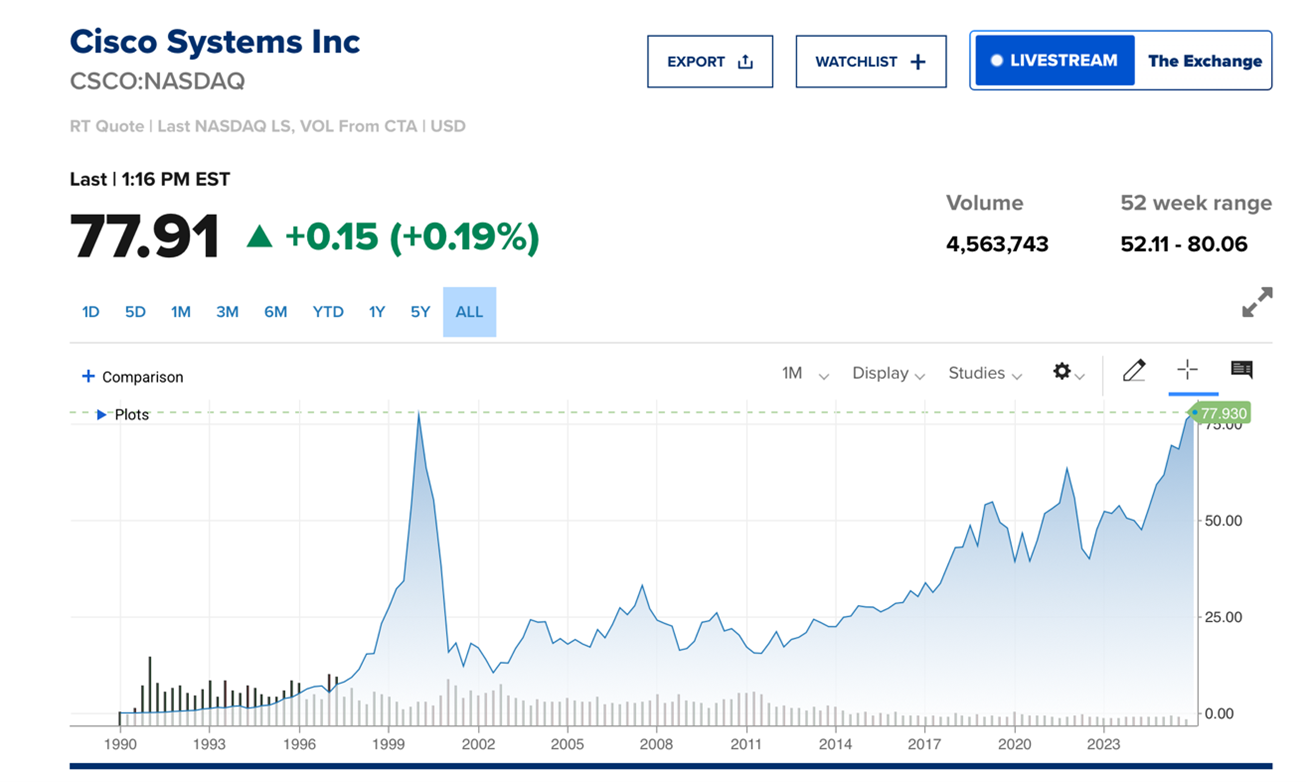
After over 25 years, Cisco Systems recently got back to its 1999 internet mania high…
Source: CNBC
Last week, Warner Bros. Discovery announced they would sell themselves to Netflix. Warner Bros. Discovery was previously Time Warner, which in January 2000 had agreed to merge with AOL, giving AOL a majority of the combined companies!!! AOL back then was a fast growing, transformational internet company, that provided dial-up service to the internet and email for its 30 million subscribers. Time Warner’s management had a severe case of FOMO back then.
The AOL Time Warner merger has been called one of the worst mergers in history as within a few years, AOL’s customers switched to much faster broadband internet access services, powered by the glut of fiber and Cisco System networking equipment. Ted Turner, who sold his Turner Broadcasting System to Time Warner in 1995, estimated he lost 80% of his wealth due to the AOL Time Warner merger.

Time Warner CEO (left) “celebrating” his merger with AOL CEO (right)…
Source: Chris Hondros/Newsmakers
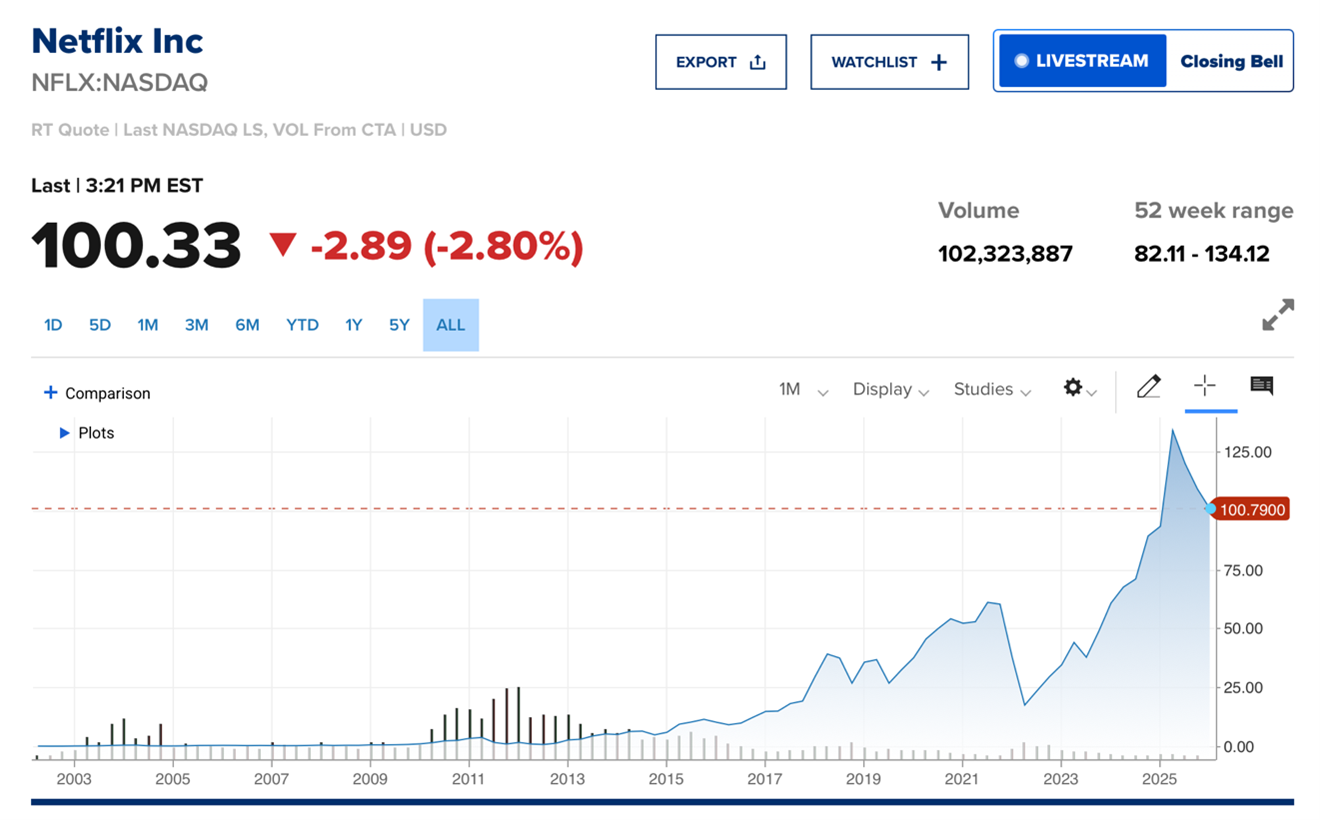
Netflix, founded in 1997 and went public in 2002, took advantage of the glut of cheap internet capacity to grow its DVD rental business, without brick & mortar stores, to put Blockbuster out of business. Netflix, then leveraged the cheap cloud infrastructure to pivot away from physical DVDs to streaming, allowing it to have 230 million binge-watching global subscribers.
Netflix has 230 million plus loyal & active users, providing them tremendous scale to produce/distribute content…
Source: CNBC
Today, investors are pouring money into AI as the new fast growing transformational industry and investors need to follow Buffett’s advice on investing into companies with wide moats rather than chasing momentum stocks due to FOMO.
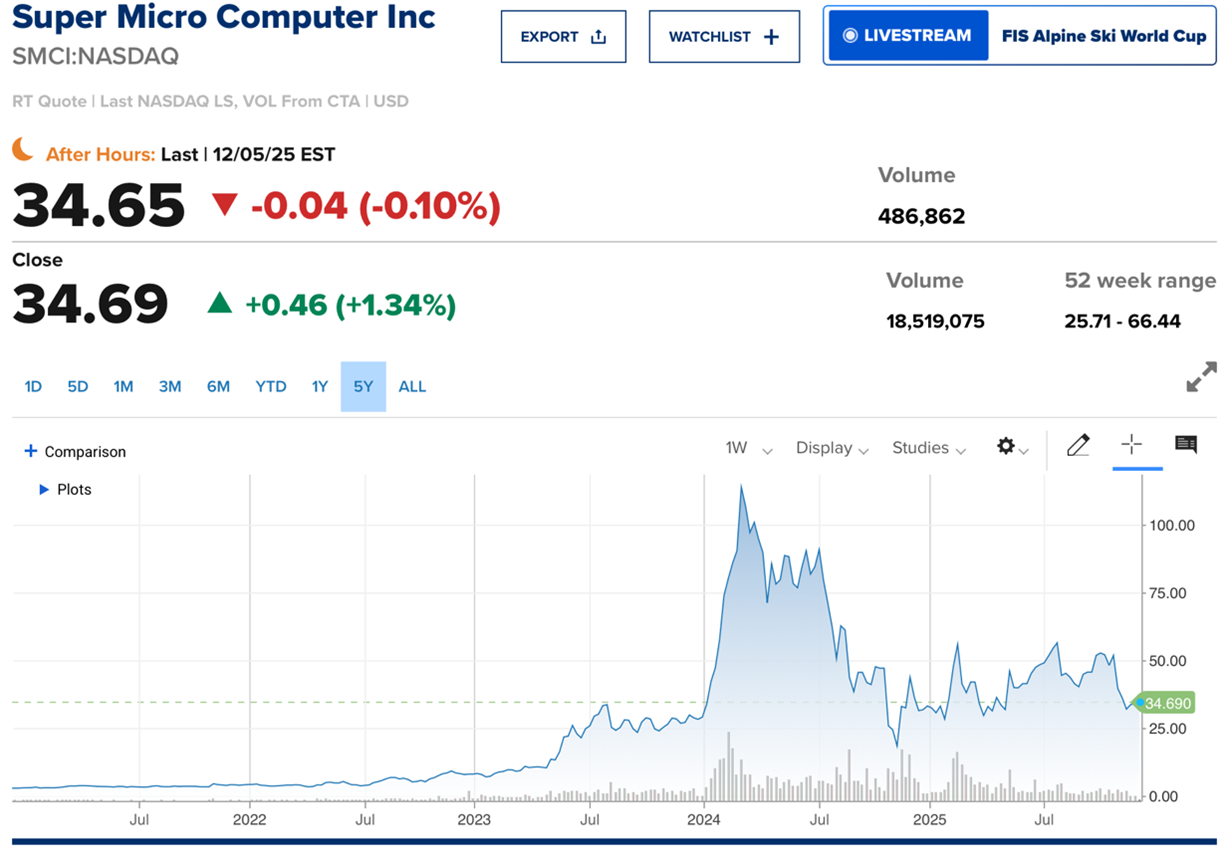
Super Micro Computers Inc. (SMCI) is one that I have highlighted in the past as one to avoid as they do not have a wide moat. The temporary advantage they had was access to Nvidia GPUs.
SMCI peaked at the height of the shortage in Nvidia GPU and has given back all its breakout gains…
Source: CNBC
SMCI’s AI servers and products are heavily focused on Nvidia’s older Hopper GPUs rather than Nvidia’s latest Blackwell GPUs. While Nvidia has historically had a 2-year cycle for their GPUs, they cut that to one year by introducing the Blackwell GPU much sooner than anticipated as they attempted to monopolize the data center market. Competition is also coming on as AMD’s alternative chip is gaining traction as they have entered into a financial agreement with OpenAI to use its chip. Chip buyers don’t like monopolies and they want to have at least two sources.
In addition, the AI infrastructure build out is shifting away from the training phase (which requires a lot of general-purpose GPU computing power) to the inference (predictive) phase, which will use more application specific integrated circuits (ASICs) to target a specific application/task. Meta has recently announced that they will expand the use of custom ASICs.
The AI market is also making a shift from Large Language Models (LLM) that require intensive usage of GPUs (expensive) to Small Language Models (SLM) that use a variety of low-cost chips that run locally at the edge, closer to the users/devices avoiding the cloud/data centers.
Overall, SMCI is a low-quality commodity player in AI as you can see from its low net margins and high debt…

Source: CNBC
Other than having access to Nvidia’s Hopper GPUs when there was a shortage, Hopper is less valuable now because of the Blackwell release (why buy a 2025 car when the 2026 model is out; if you do buy a 2025, you would want a discounted price). SMCI is a commodity player as indicated by their net margin of only 3.80%. As their net profit is only $3.80 for each $100 of sales, this requires them to take on debt to purchase high-cost GPUs, leading to a high debt to equity ratio of 73.21%. This is not a company with a wide moat!!
Following Buffet’s warning on transformational industries, I am cautious on the AI infrastructure space, as it is becoming increasingly competitive since OpenAI launched over 3 years ago.
The ultimate winners from AI will be any company that has a sticky client base where they can adopt AI products/services for their clients at minimal to no costs.
Netflix did not invent the internet or cloud, they just used it to add value to their clients and expand their business model; they took their clients from physical DVDs delivered by snail mail to streaming which allowed binge-watching and led to higher engagement and higher retention of their clients. AOL’s management didn’t embrace broadband (which led to no retention of their clients) and instead pivoted to content and advertising with Time Warner. Time Warner made a serious mistake in selling to AOL just before AOL’s business collapsed.
Buyer beware in AI.

Until my next quarterly commentary..
Happy Holidays!
John Lui
Disclosure
Chatham Wealth Management is registered as an investment adviser with the SEC. SEC registration does not constitute an endorsement of the firm by the Commission, nor does it indicate that the adviser has attained a particular level of skill or ability.
Past performance may not be indicative of future results. All investment strategies have the potential for profit or loss. Different types of investments involve varying degrees of risk, and there can be no assurance that any specific investment or strategy will be profitable for a client's portfolio.