
Q3 2026 Market Recap

By Dan Moskowitz, CFP® President and Chief Investment Officer
The third quarter of 2026 delivered a tale of two markets. The S&P 500 gained approximately 2.7% during the quarter, but the path to that return was far from smooth. The market was nearly flat in July as an oil price spike rattled sentiment. Stocks recovered in August as corporate earnings came in strong and then gave back some ground in September as interest rates moved higher following the Fed's September 16 rate hike.
Bonds had a tougher quarter with the Bloomberg US Aggregate Bond Index returning approximately -3.3% as rising yields weighed on prices. This marks a modestly negative result for the third consecutive quarter.
Sector Performance: Energy Dominates, Rate-Sensitive Sectors Suffer
Energy (+18.1% Q3, +41.3% YTD) dominated, driven by the Iran conflict and Strait of Hormuz supply risk. Health Care (+8.0%) and Information Technology (+7.6%) also delivered, as the AI infrastructure buildout continued to support earnings growth.
On the other side, Utilities (-12.2%) was the quarter’s worst performer as rising rates make dividend yields less competitive. Industrials (-7.1%) also struggled giving back earlier gains as oil prices surged, interest rates moved higher and the AI-related momentum trade cooled. The quarter reinforced the defining pattern of 2026: hard assets, energy, and AI-driven revenue outperform; rate-sensitive businesses do not.
The Rate Reality Has Arrived
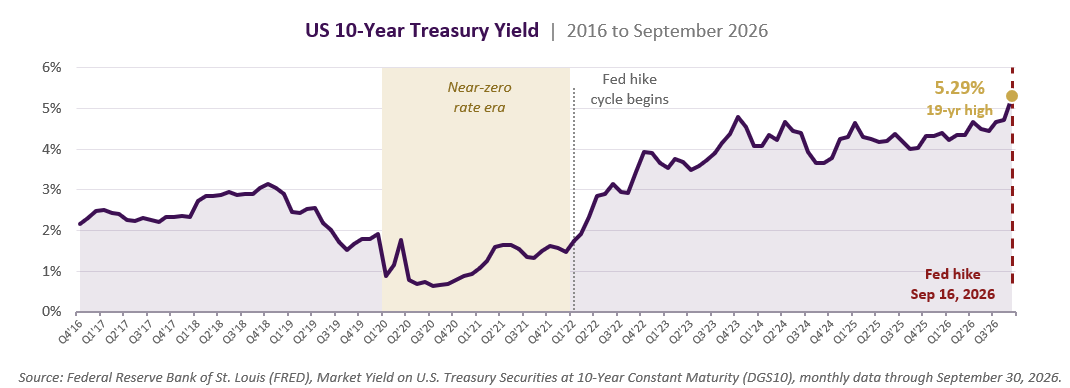
For the better part of two years, we argued that rates would stay higher for longer. That view has been validated. The 10-year Treasury closed September at 5.29%, a 19-year high and the 30-year hit levels not seen since 2004. The Fed hiked 25 bps on September 16, and the bond market responded with another selloff, still working through how far rates ultimately need to go.

On September 17th, Rob Moskowitz and I were in attendance to hear DoubleLine Capital’s Jeffrey Gundlach’s view that rates have further to travel, and that the interaction between elevated borrowing costs, AI debt issuance, and private credit stress creates a challenging environment for fixed income investors. He noted the 2-year sitting well above the fed funds rate as evidence the market expects more work ahead and warned the next recession could challenge Treasuries’ traditional safe-haven role.
AI Debt Problem
The hyperscaler buildout is consuming capital at an unprecedented pace. Microsoft, Amazon, Google, and Meta alone are on track to spend roughly $750 billion on AI infrastructure in 2026. That debt is showing stress. Oracle’s CDS spread has blown out to nearly 200 basis points. Gundlach’s warning: “AI bonds see spreads blow out within days of issuance” a credit signal that typically reaches equity markets later. The AI trade is real and transformative but the scale of debt being issued to finance it warrants careful monitoring in a higher-rate environment.
Private Credit: Can’t Trust the Markets
Private credit is showing the stress of a higher-rate world. Non-traded BDC redemption requests averaged 12.1% of NAV in Q1 2026, more than double the standard 5% cap. Blue Owl’s tech-focused vehicle saw 40%+ withdrawal attempts in a single quarter. PIMCO warned that BDC valuations are now “increasingly driven by manager-specific assumptions rather than a shared market-clearing level.” When you can’t trust the marks (they are deliberately not putting real prices on all holdings), you can’t trust the NAV. Our caution on private credit is proving warranted.
Where We See Value and How We’re Positioning
Our CIO John Lui highlighted in his June commentary that our equity positioning remains focused on high-quality companies, dividend payors, dividend growers, and growth companies with reasonable valuations as we see risk of a valuation correction growing.
Newer Areas of Focus
For investors in high tax brackets, the taxable-equivalent yield on a municipal bond ladder is among the most compelling we’ve seen in years. We are deliberately keeping duration shorter at this stage of the cycle, where we believe the risk-reward is most attractive.
We are also adding non-dollar bonds held in local currencies. With $40 trillion in US national debt and a Fed still arguably behind the curve, some currency diversification away from the dollar is not a call against the US. It is prudent portfolio construction.
With rates having moved higher faster than we even expected, we would not be surprised if the stock market has a -10% correction. We are risk managers and part of risk management is making sure clients are diversified and hold high-quality securities. We have been doing this for our clients for more than 40 years. This should allow everyone to sleep at night.
Disclosure
Chatham Wealth Management is registered as an investment adviser with the SEC. SEC registration does not constitute an endorsement of the firm by the Commission, nor does it indicate that the adviser has attained a particular level of skill or ability.
Past performance may not be indicative of future results. All investment strategies have the potential for profit or loss. Different types of investments involve varying degrees of risk, and there can be no assurance that any specific investment or strategy will be profitable for a client's portfolio.